


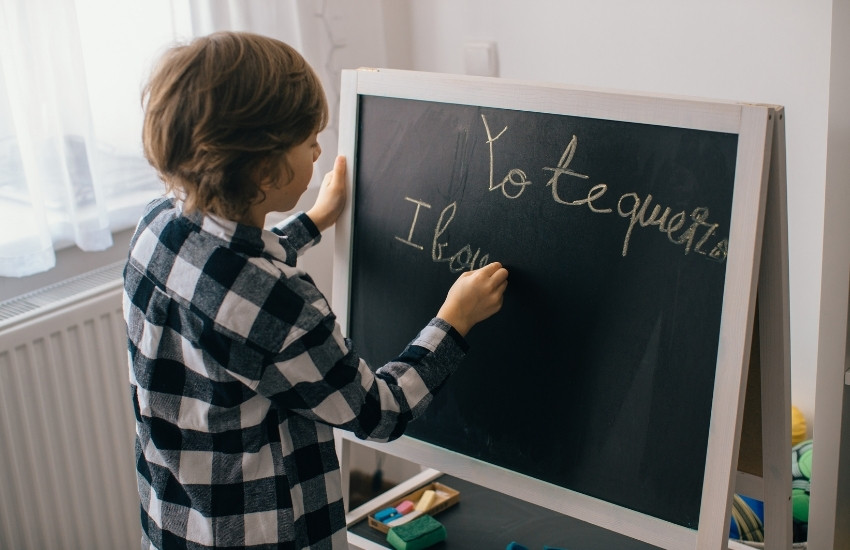
Many different languages are spoken in Australia. According to Australian Early Development Census (AECD) data, over a quarter of Australian children have a Language Background Other Than English (LBOTE). Census data from 2021 show that the most frequently used languages at home, aside from English, were Mandarin, Arabic, Vietnamese, Cantonese, and Punjabi. Additionally, over 150 Aboriginal or Torres Strait Islander languages were reported to be actively spoken. Many Aboriginal and Torres Strait Islander people speak Aboriginal Australian English.
What does it mean to be bilingual?
Being bilingual refers to the ability to understand and/or use two languages. Bilingual language learning can occur by a child being exposed to both languages from infancy (simultaneous bilingual) or a child can be exposed to their first language from infancy, with a second language introduced later in childhood (sequential bilingual). This often occurs when the child starts at an early learning setting or school. It’s also possible to be an “active” bilingual, during which a child uses and comprehends both languages, or a “passive” bilingual, where conversations between native speakers in one of the languages are understood but there is no use of the language.
How do children learn two languages?
Bilingualism can offer many advantages for children. Bilingualism does not cause or contribute to speech, language, or communication disorders. Each child’s development is unique, and learning can be influenced by how often they hear the languages, what languages they are learning, and the contexts in which the languages are used. Bilingual children generally learn speech and language differently from monolingual children. It can be common to use “code-switching”, meaning that children switch between languages within a sentence/conversation. It can also be common for “interference” to occur, which means the structure of one language (e.g., sounds, grammar) influences the other.
Understanding the silent period and code-switching
Some children even experience a “silent period” during which the child is immersed in the second language, and engages in active listening, but there is little output of the language. When the child starts speaking, it is often in sentences. Whilst this is something that can happen, we caution against “wait and see” if you have any concerns about your child's language development.
When to seek support for speech or language concerns
Nevertheless, some bilingual children will experience a language disorder, or Developmental Language Disorder (DLD). DLD is a significant difficulty in learning, understanding, and using spoken language. More information on language disorders is available here RADLD - Raising Awareness of Developmental Language Disorder - RADLD. When a bilingual child experiences DLD, it will appear across both of their languages. If you have any concerns about your child’s speech or language development, it is recommended to seek an assessment through a speech pathologist.
Developmental language disorder (DLD) in bilingual children
Speech pathologists in Australia advocate for children to learn and use their home languages. It is generally understood that ongoing use of a child’s home language results in positive educational and social-emotional outcomes for children. As mentioned above, bilingualism does not cause or contribute to speech, language, or communication disorders.
Why maintaining a home language matters
Further information can be accessed here:
- Raising Children Network: About multilingual & bilingual children | Raising Children Network
- Communication Hub: Supporting multilingual childrens communication development
- South Eastern Sydney Local Health District: Helping your child learn two languages
- SBS Podcast - My Bilingual Family: My Bilingual Family | SBS Audio
How Inner West Paediatrics can support your child’s language journey
For families seeking support, Inner West Paediatrics offers services for children experiencing language difficulties. Our team is dedicated to providing compassionate and individualized care to support your child's language journey.
📞 Reach out to the team at Inner West Paediatrics to book a consultation or learn more on (02) 9560 8905, info@innerwestpaediatrics.com.au or through our website


